The Practice that Taught Me to Trust Life
A dyad practice for secure attachment — not just with each other, but with life itself.
It probably looks strange from the outside.
Two grown adults in the kitchen, arms locked, pushing into each other with real force. No one is fighting. No one says much except for some growling. A few minutes later, one of us is crying, or laughing, and something that had been sitting in my chest and creating distance all morning is just — gone.
This is what my wife Kiki and I do when one of us feels the wobble. That moment when secure attachment slips — not just with each other, but with life itself: a conversation that went sideways, a flash of anger with nowhere to go, the fear that life is moving too fast. Underneath each one, the same question: is life still holding me?
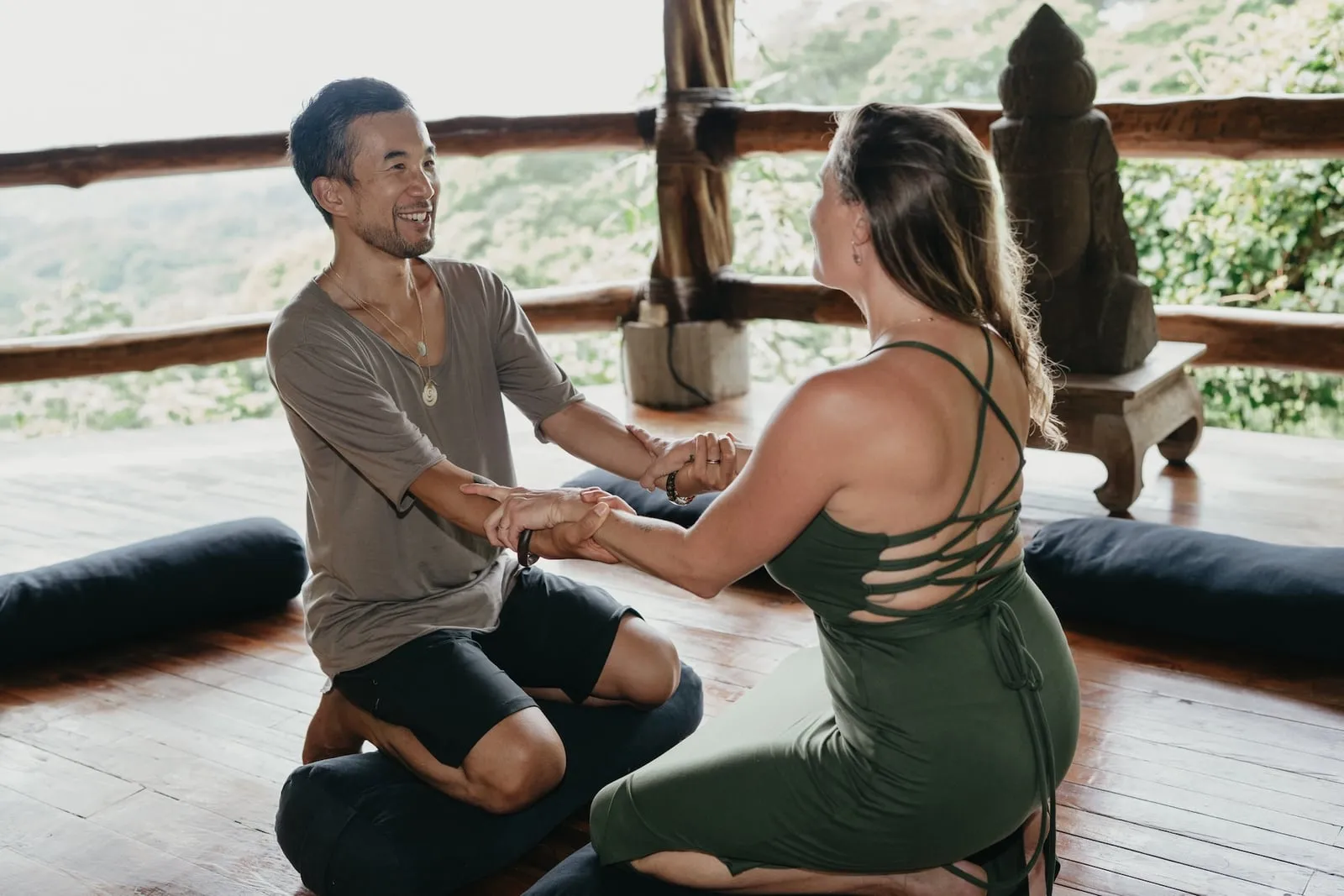
We stick out our arms. We push and pull whatever sensation is in the body. We make contact with the places in ourselves holding the charge.
Five years ago, this began out of necessity. Our marriage could get taken over by rupture. We knew how to fight, how to withdraw, how to live together with our hearts closed. What we didn’t know was how to consistently find our way back.
The embodied, relational practice we eventually found is simple to describe: two people drop beneath the words and the stories. One goes into the material that’s most alive and charged. The other meets them there — at the level of the body and nervous system, where words are often just a way to pop out of the experience.
We call it dyad. We practice it nearly every day, and it’s become a way of life.
When the material is finally met there, charge moves — anger, rage, grief, collapse, whatever has been living in the body. Done with precision, it works like an acupuncture needle: finding the exact spot where life is pressing for contact, and meeting it until it moves.
It has taken us, more times than I can count, from “f*ck you, you’re the problem” to “why yes, I do want to f*ck you.”
It started as the thing that saved our marriage. Slowly, it became the way we meet everything — fear, grief, work, money, beauty itself.
Before our session with Edmond, we could touch our bodies and still miss each other completely — we’d come in for a hug, and both wonder, where are you? After one arc of work, we still touch and cuddle, but now I get to be nourished and feel connected. This is the essence of attachment work.
— Dan Jednyak, after a dyad session
The more we practice, the more we rest into a secure attachment with life itself — knowing we can meet any experience life shows us. We can trust that life is holding us. We can trust that life will meet us.
After our last few gatherings, people kept coming up and asking to learn the practice.
So this August, for the first time, we’re teaching it.
A founding cohort called True Contact — four Tuesday evenings, August 4–25, 5–7:30pm, in person in North Boulder. Six people.
Though dyad started as a couples practice, it’s evolved into a practice we now do with anyone. The material it works on is yours alone — your history, your charge, the places in you that brace against life. You’ll practice with another person, but your practice partner is not the content of the work. They’re the presence through which your material gets met. You come as yourself, for yourself.
You’ll learn to meet charge and intensity in your own body without popping out into story. To attune to another person beneath the words, at the level of the nervous system. To let your body hold more charge and power — the capacity that translates directly into creating real change in your life. And to meet the places where your trust in life itself wobbles — in relationship, in work, in family — and find contact there instead of collapse.
We’re discounting this founding cohort in exchange for three things: your full presence at every session, your honest feedback after each one, and your testimony at the end.
I came in feeling a lot of confusion — around purpose, relationships, and where I’m heading. Through this process, something much deeper revealed itself: a profound distrust of life itself. I’m someone who has done a lot of inner work, yet this practice reached a layer that thinking alone couldn’t touch. It felt as powerful as a medicine journey — without any medicine.
— Jessyca Jordan, on the dyad practice
If something in you resonated while reading this, come join us.